
Posted in Asset Protection,Probate & Trust Administration,Real Estate Law,Wills, Trusts & Estate Planning
Florida’s homestead laws provide some of the strongest protections in the country, but those protections can become surprisingly complicated when a homeowner dies. Who receives the home? Can it pass according to the owner’s will or trust? And will it remain protected from the deceased owner’s creditors?
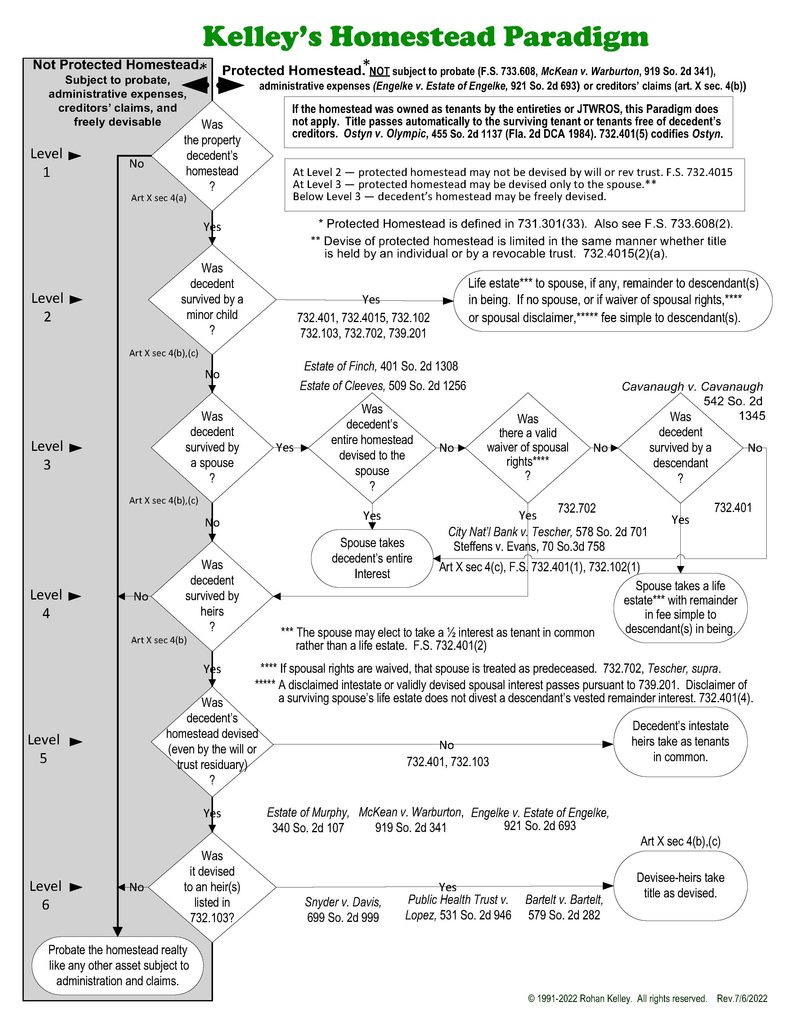
Kelley’s Homestead Paradigm, created by Florida attorney Rohan Kelley and first published in The Florida Bar Journal in 1991, provides a helpful framework for analyzing these questions.
Why Florida Homestead Is Different
Under Article X, Section 4 of the Florida Constitution, qualifying homestead property receives important protections. Those protections do not necessarily end when the homeowner dies. Whether the property remains protected and who ultimately receives it depend on several factors, including the homeowner’s family circumstances and estate plan.
Kelley’s Homestead Paradigm approaches the issue through a series of questions:
The answers can lead to very different results.
A Surviving Spouse or Minor Child Can Change the Estate Plan
Florida law restricts how homestead may be devised when the owner is survived by a spouse or minor child.
If a minor child survives the homeowner, Florida law generally prohibits the devise of the homestead. If the homestead is not validly devised and the owner is survived by a spouse and descendants, Section 732.401 gives the spouse a life estate with the remainder to the descendants. Alternatively, the spouse may elect, within six months of death, to take an undivided one-half interest as a tenant in common.
When there are no minor children but there is a surviving spouse, a devise of protected homestead is generally limited to the spouse in fee simple unless applicable spousal rights have been validly waived.
These rules differ if the real property is jointly owned and are one reason a will or revocable trust should not be reviewed in isolation from the way the owner’s homestead is titled and the client’s family circumstances.
What Happens When There Is No Spouse or Minor Child?
When the homeowner is not survived by a spouse or minor child, there is considerably more flexibility in the disposition of homestead. However, who receives the property can still affect creditor protection after death.
As the paradigm illustrates, property passing to persons who qualify as the decedent’s heirs under Florida’s intestacy laws, such as children, parents, or siblings, may retain its protected-homestead status. Conversely, a devise to someone outside the statutory class of heirs can result in the property losing that protection and becoming available for estate administration expenses and creditor claims. This distinction can make the identity of a beneficiary just as important as the language used in the estate planning documents.
Titling Matters Too
There is another important consideration for married couples. If homestead is owned as tenants by the entirety, the surviving spouse ordinarily becomes the sole owner upon the first spouse’s death by operation of law. Similarly, property held as joint tenants with right of survivorship passes automatically to the surviving joint owner(s). Florida Statutes Section 732.401(5) excludes these survivorship interests from the statutory homestead descent provisions addressed by the paradigm. That means the way a deed is prepared during life can dramatically affect what happens at death.
Special Concerns for Blended Families
Homestead planning deserves particular attention in a second marriage or blended family. For example, a married homeowner with adult children from a prior relationship may want the home ultimately to pass to those children. Florida’s homestead restrictions can interfere with that plan when a surviving spouse is involved.
Depending on the circumstances, a properly executed waiver of homestead rights may be part of the planning solution. But these arrangements should be addressed before death rather than assuming the terms of a will or trust will control.
Why Homestead Should Be Part of Your Estate Planning Review
Florida homestead law demonstrates why estate planning involves more than simply preparing a will or trust. A complete plan should consider:
A provision that appears straightforward in a will or trust may produce a very different result once Florida’s constitutional and statutory homestead rules are applied.
Review Your Florida Estate Plan Before a Problem Arises
Homestead is often one of a family’s most valuable assets, and Florida law gives it unique treatment. Thoughtful planning can help ensure that the property passes in the manner intended while avoiding unintended consequences for a surviving spouse, children, other beneficiaries, and the estate.
If you own a Florida homestead, particularly if you have a blended family, minor children, a revocable trust, or specific wishes about who should receive your home, consider having your deed and estate planning documents reviewed together.




(904) 823-3333
1301 Plantation Island Drive, Suite 304
St. Augustine, Florida 32080
Jackson Law Group © 2007-2026 – All Rights Reserved
Legal Notice • Sitemap
